
Penetration Testing
Adversarial testing across your external, internal, and application attack surfaces.
Penetration testing, adversary simulation and security research across applications, infrastructure and identity.
Serving organizations nationally, with deep experience in critical infrastructure, local government, and regulated industries.
Every engagement is scoped to your environment, executed by senior operators, and delivered with findings your teams can use.
Adversarial testing across your external, internal, and application attack surfaces.
Objective-based operations, assumed breach, and phishing, vishing and physical testing that measure whether your people and your defenders detect and respond.
Attack paths through AWS, Azure, GCP and hybrid identity, from the outside in and from a compromised account outward.
One weakness, what it enabled, and what fixed it. Client work stays under NDA, so the evidence here comes from our published research.
Our analysis and checker
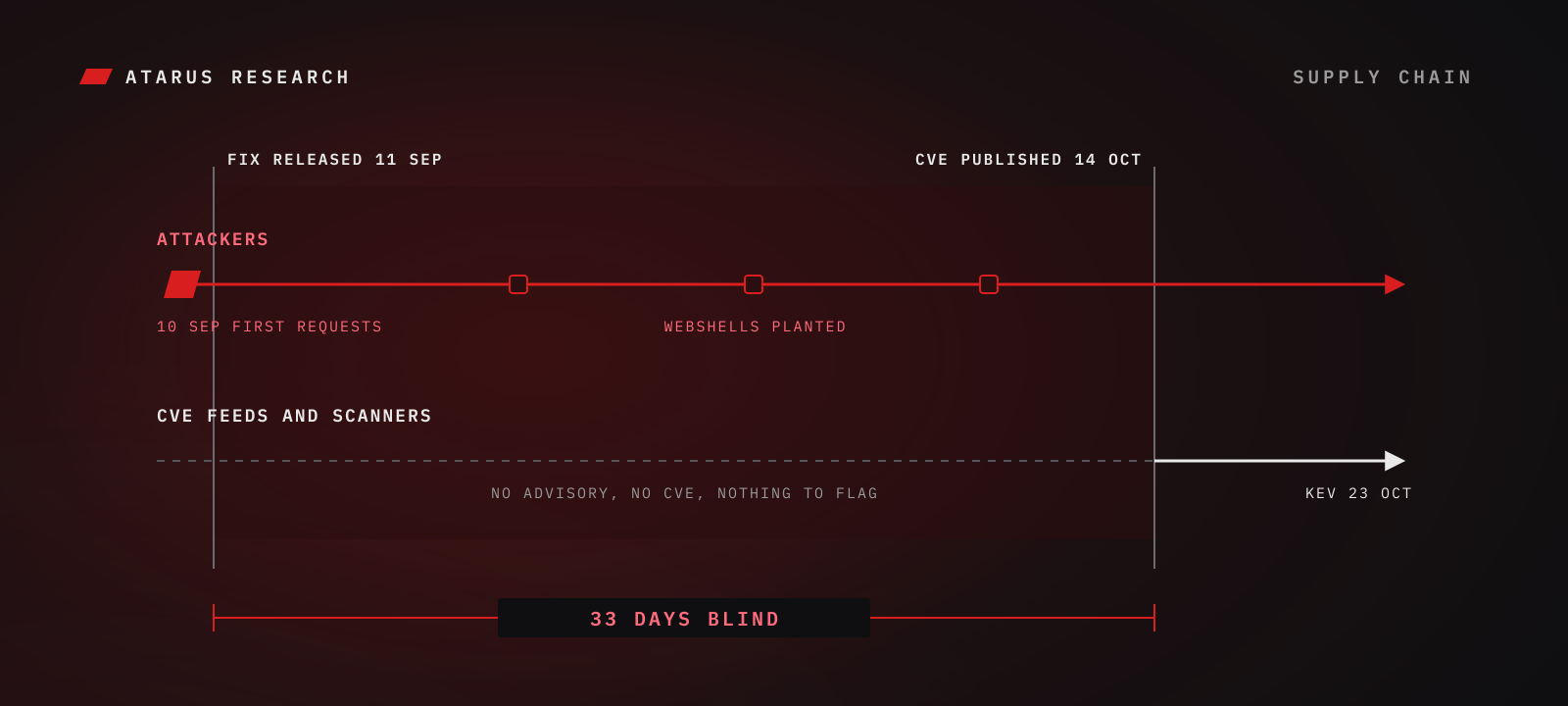
The fix step. atarus-phpcheck Finds the runtimes that are really fixed, the ones on branches PHP no longer patches, and the interim settings. It never triggers the bugs.
Read the analysisWhat we publish: how current attacks work, what they exploit, and what stops them, plus the tools we release for any team to use.
CVE-2026-110447 is an unauthenticated OS command injection in the Collabora Online Built-in CODE Server app for Nextcloud, rated CVSS 9.2.
Detection and inventory for PHP CVE-2026-109618 and CVE-2026-109619: versions, SAPIs, mitigating settings. Never triggers the bugs.
Also on GitHub: atarus-recon atarus-cloud atarus-webscan atarus-report-kit atarus-phishcheck See all tools
These are free because we would like fewer avoidable breaches, and they are the checks we run on every engagement.
Decode a token, read its expiry as a date, and catch alg none, algorithm confusion, missing exp and long lifetimes.
Parse a Content-Security-Policy and see which directives leave script injection open, with the fix for each.
Paste response headers from curl or devtools and get HSTS, CSP, framing, cookies and caching graded.
Read SPF, DMARC, DKIM, MX, CAA and A records the way a tester does, from a public DNS over HTTPS resolver.
Web app recon: the first hour of a pentest
Map a web app before attacking it: proxy every request, read the headers, pull API routes from JavaScript bundles and list every input worth testing.
External recon and subdomain enumeration
Map everything a domain exposes on the internet: names from DNS and certificate logs, dangling records, open ports and edge devices, each with its fix.
How to write a pentest finding
Write a security finding an engineer can reproduce and fix without a call: impact title, severity reasoning, rerunnable steps, the fix, the retest.
Working with Atarus
All initial consultations are confidential and covered under mutual NDA. References and sample redacted deliverables are available upon request.