
The Atarus series
Foundations.
From your first terminal to your first finding. This book takes you from ordinary computer use to the point where a penetration testing course makes sense, and every output it prints is a captured run. It is published in three volumes, Foundations I, II and III, each in a lab edition and a reading edition.
- Foundations I to III
- In development
- Editions
- Lab and reading
- Price
- 19.99 USD a PDF
- Length
- 26 chapters, about 140 hours
Who it is for
People who have never administered a computer.
- You use a computer every day and have never administered one.
- You can install software, use a browser and manage files, and have never opened a terminal on purpose or run a virtual machine.
- You work on a help desk, write software, study, are changing career, or run IT and want to know what testers do.
The book assumes no programming. It teaches enough shell and Python to read a script and change a line. You build a lab on your own laptop in chapter 1 and use it in every chapter after. By the last chapter you can pass a twenty-item checklist with that lab in front of you, and you have written one finding that a developer who was not there can reproduce.
If you already administer Linux or Windows, skip chapters 2 to 5, 8, 15 and 19. Each opens with a skip condition you check from your own lab. If you already work in IT, you can start at Foundations III: it opens with a way to bring your lab to where chapter 17 begins without the earlier chapters.
The three volumes
Twenty-six chapters in three volumes.
Chapter numbers run across all three volumes, because the run ids, the snapshot names and the notes commits in the chapters carry them. About 140 hours of reading and lab work in all; at seven hours a week that is twenty weeks, and plan two more for labs that break.
-
Chapters 1 to 9
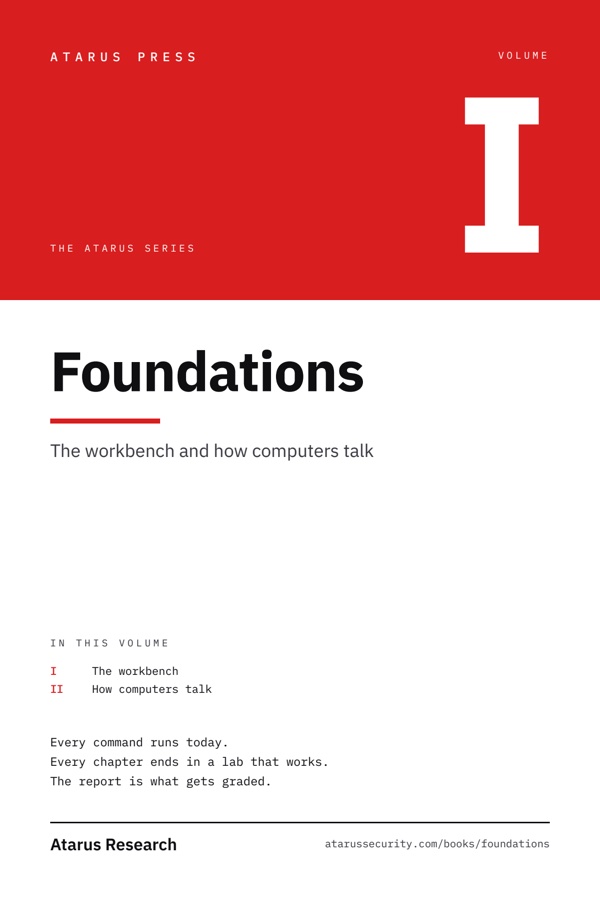
Foundations I
The workbench and how computers talk
-
Part I The workbench
The lab and how to work in it: the bench virtual machine, Linux and Windows from the command line, scripts, git and the notes you keep.
-
Part II How computers talk
Addresses, ports and routes; DNS; HTTP; TLS and certificates; reading your own traffic in Wireshark.
Contents
- Chapter 1. Build your lab
- Chapter 2. Linux from the command line, enough to be dangerous
- Chapter 3. Windows from the command line , In writing
- Chapter 4. Scripts, git and notes
- Chapter 5. Addresses, ports and routes
- Chapter 6. Names: DNS
- Chapter 7. HTTP: the request and the response
- Chapter 8. TLS and certificates: what encryption does and does not hide
- Chapter 9. Reading traffic: Wireshark on your own lab
-
-
Chapters 10 to 16
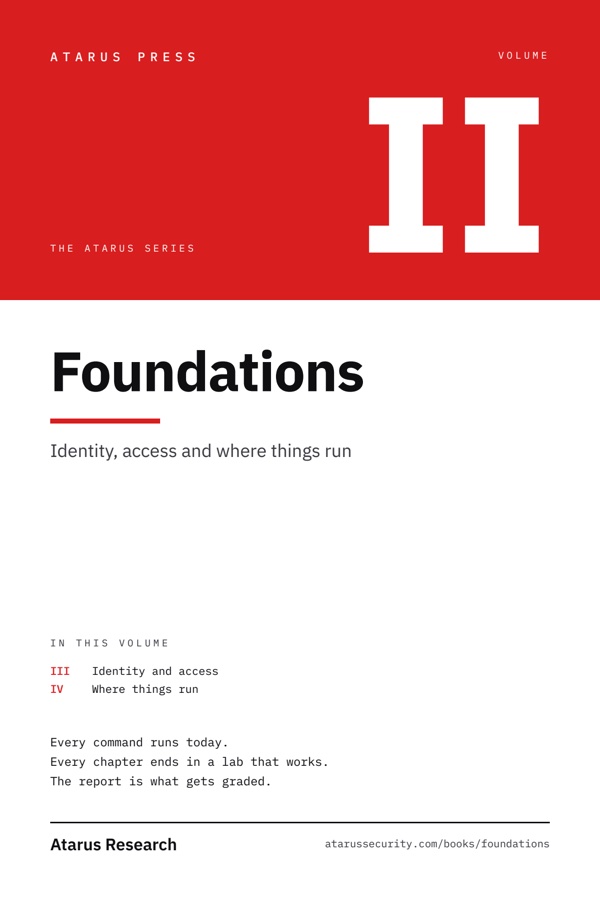
Foundations II
Identity, access and where things run
-
Part III Identity and access
Passwords and hashes, sessions and tokens, Active Directory and Entra ID, then OAuth and OpenID Connect.
-
Part IV Where things run
A cloud account from the inside, containers and Kubernetes, and the pipelines that turn code into running services.
Contents
- Chapter 10. Accounts, passwords and hashes: why a stored password is not a password
- Chapter 11. Multi-factor authentication (MFA), sessions and tokens: cookies, bearer tokens and JWTs
- Chapter 12. Directories: Active Directory and Entra ID , In writing
- Chapter 13. Delegated access: OAuth, OpenID Connect and policy , In writing
- Chapter 14. A cloud account from the inside , In writing
- Chapter 15. Containers and Kubernetes in one afternoon
- Chapter 16. Pipelines and secrets , In writing
-
-
Chapters 17 to 26
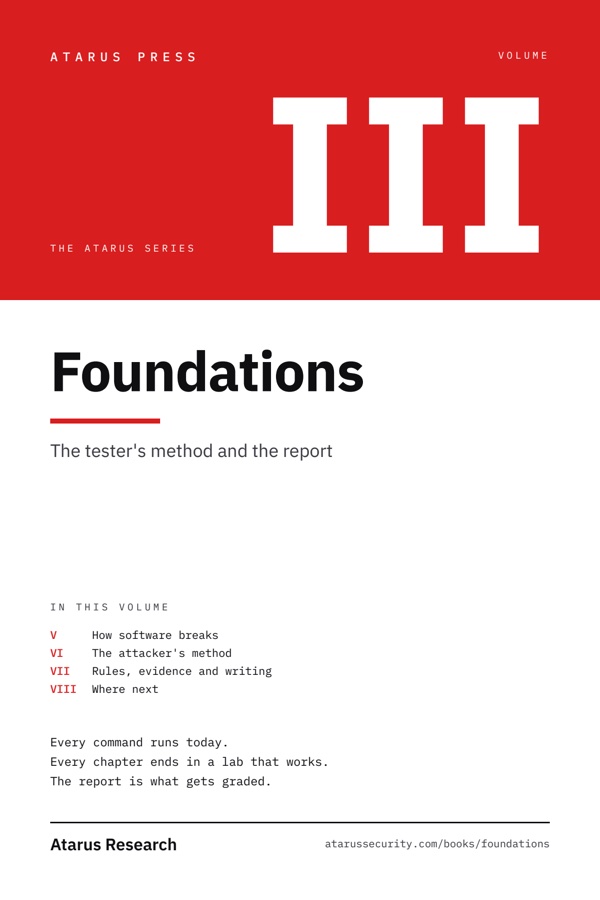
Foundations III
The tester's method and the report
-
Part V How software breaks
The classes of weakness, misconfiguration as the largest of them, and how to read an advisory and a CVE record.
-
Part VI The attacker's method
The kill chain used across the series, recon and the first hour, and the log each step leaves for a defender.
-
Part VII Rules, evidence and writing
Scope letters and the law, the operator log and the evidence package, and writing a finding.
-
Part VIII Where next
The exit checklist in one sitting, and how to choose the next book in the series.
Contents
- Chapter 17. Classes of weakness, not exploits
- Chapter 18. Misconfiguration, the bigger class
- Chapter 19. Reading an advisory and a CVE
- Chapter 20. The kill chain as the spine
- Chapter 21. Recon and the first hour
- Chapter 22. The defender's view: every step leaves a log
- Chapter 23. Rules of engagement and law
- Chapter 24. Evidence: the operator log and the evidence package
- Chapter 25. Writing a finding: the Learn structure, applied
- Chapter 26. The exit checklist and choosing a phase volume
-
Lab edition
Every chapter with its labs: the setup steps, the checks at the end of each chapter, the failure sections with their fixes, and the appendices.
Reading edition
The same chapters and every captured output, printed as what we ran, without the lab setup, the checks, the failure sections or the appendices.
Both editions of a volume come with it, in the same reader account. Running the labs is how the checklist in Foundations III, chapter 26 becomes something you can pass. Reading without running anything works too: every output is printed in full.
How you get it
A PDF per volume, in your reader account.
The volumes are delivered through the student portal, and are in development. The reader account that holds them opens no later than they do.
- Each volume is 19.99 USD as a PDF, both editions included, and 29.99 USD as a paperback. The three PDFs together are 44.99 USD. None can be bought yet.
- Everyone who signed up for the reader library or joined a list for Foundations before it became paid keeps the three Foundations PDFs free.
- The PDFs are delivered through the student portal: one reader account holds every volume, edition and update you have.
- Without an account you can read the contents, one sample chapter and the Learn pages: the contents are on this page now, and the sample chapter is open when the volumes publish.
- The bench image, with its signature and checksum, and the setup guide come free with a reader account.
- Signup is not open to residents of the EU, EEA or UK.
The Learn library
The pages the chapters read.
Where a chapter has a Learn page under it, the chapter says so and the page is free on this site. Each page is written for a test with written permission, so the book has you read it and run nothing from it against a system you do not own.
| Chapter | Learn page |
|---|---|
| 6. Names: DNS | SPF, DKIM and DMARC: test email spoofing |
| 7. HTTP: the request and the response | Web app recon: the first hour of a pentest |
| 11. Multi-factor authentication (MFA), sessions and tokens: cookies, bearer tokens and JWTs | Authentication and session testing |
| 15. Containers and Kubernetes in one afternoon | Kubernetes pentest: RBAC, secrets, admission |
| 18. Misconfiguration, the bigger class | Public bucket checks: S3, Azure Blob, GCS |
| 21. Recon and the first hour | External recon and subdomain enumeration (read alongside) |
| 22. The defender's view: every step leaves a log | AWS CloudTrail and GuardDuty evidence review |
| 24. Evidence: the operator log and the evidence package | Cloud evidence package and operator log |
| 25. Writing a finding: the Learn structure, applied | How to write a pentest finding |
What you need
A laptop and a free hypervisor.
- A laptop with 16 GB of memory and 100 GB of free disk: a Mac with Apple silicon, or a Windows or Linux PC with an x86 processor.
- A hypervisor: VMware Fusion on a Mac, VirtualBox on a PC. Both were free to download on 31 Oct 2026.
- The bench image, a free download in the student portal with your reader account, with its signature and checksum.
- No cloud account. Foundations runs on your laptop. The one cloud chapter has an Optional lab on a free account with a budget alarm set first.
Each lab names the day its free components were last checked. Appendix A of the lab edition lists every component of the bench with its pinned version.
Reading only
You can follow every chapter without running anything.
Every output is printed in full with its run id beneath it, so each step shows the command, the real output and one sentence on what it means. The reading edition keeps all of that and leaves the lab setup out.
In the lab edition, labs are marked Core or Optional, and each ends with a line naming where the prose resumes, such as "Reading only? Continue at What the log kept."
The running company
Wrexby Outfitters.
A fictional 180-person outdoor equipment retailer with a web shop, a warehouse, a cloud account and a directory. Every chapter builds a piece of it on your laptop; by Part VI you have a small copy of the company and walk the method against it. The same company runs through every book of the series.
Ground rules
- Wrexby Outfitters is fiction. Its people, systems, users and host names exist only inside your lab.
- The firm owns wrexby.com. It serves a small brand site with no scripts and no forms.
- The domain sends no mail and publishes records that say so, so every wrexby.com address in the books is invented.
- Recon chapters ask only for lookups anyone can make: the registration, the name servers, the DNS records, the certificate transparency entries and the pages themselves.
- Inside the lab, Wrexby machines take names under wrexby.lab, which resolve through a hosts file or a name server you run and never on the internet.
- The authorisation rule covers wrexby.com like any other site: it is not yours to test. Nothing in the book asks you to scan or attack it.
Authorisation
Use these techniques only where you are allowed to.
Use the techniques in this book only on systems you own or have written permission to test. Unauthorised access to a computer is a crime in most jurisdictions, whatever your intent. The lab targets are deliberately vulnerable; never expose them to the internet. Chapter 23, in Foundations III, covers scope, consent and the law.
How it publishes
The steps, in order.
In development. All three volumes publish together, in the order below.
-
Foundations I, II and III
All three volumes, each in a lab edition and a reading edition, delivered through the student portal, with the bench image (with its signature and checksum), the setup guide and the capture manifest.
-
Corrections and updates
Corrected editions reach the same account, and every correction is listed on the errata page.
Captures and errata
-
Captures
Every printed output, listed with its hashes
What a capture is, how run ids and hashes work, the public manifest for all three volumes and the seed scripts.
-
Errata
Corrections, and how to report one
Each correction with the chapter, the page, the wrong text, the fix, the date and whether a capture changed.