
Atarus Press
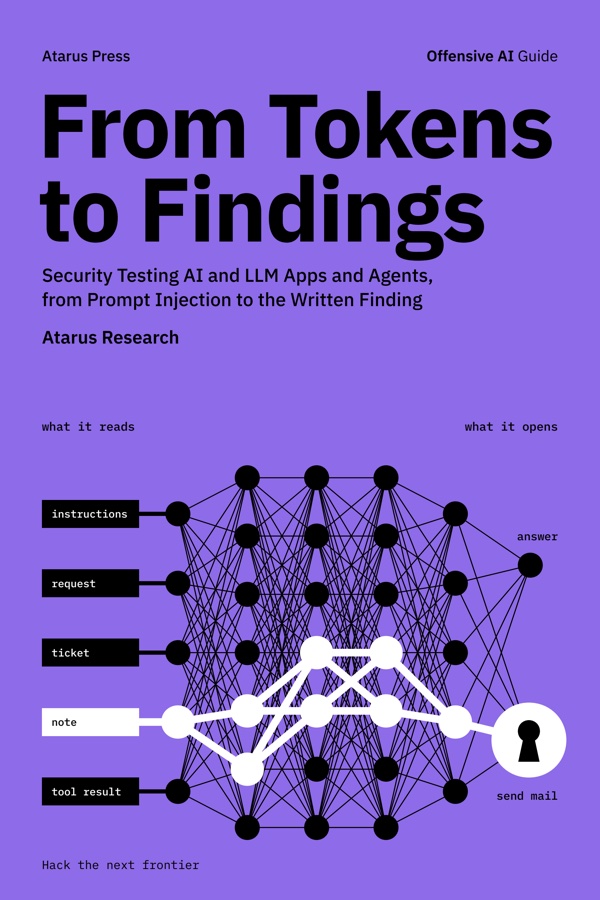
From Tokens to Findings.
A guide to security testing apps and agents built on language models. It explains what a model is and what the app around it hands it, takes twelve attack classes in ranked order from prompt injection and data theft down, and shows how to turn a result that changes from run to run into a finding an engineer can fix.
- State
- Available on Amazon
- Formats
- Paperback 34.99 USD, Kindle 12.99 USD, Hardcover 49.99 USD
- Length
- 338 pages in print, 24 chapters and a conclusion
- Edition
- First edition
- Author
- Atarus Research
- ISBN
- Paperback 9798143140752, Hardcover 9798143482166
Sold by Amazon. Prices are the US list prices; other Amazon stores set their own. This site does not sell the book and takes no payment.
The guides behind the book are open now, free and with no account: twelve pages on testing AI and LLM apps and agents.
What it is
From what a model is to the written finding.
Someone hands you an AI assistant and asks you to test it before it ships. It reads support tickets, can look up customers and send mail, and it has no reliable way to tell an instruction from data. The book shows how to test a system like that, from what a model is to the finding you write up.
Part I explains what a model reads, why the same question can get two different answers, and what an app wraps around the model: instructions, context, retrieval, tools, memory and the agent loop. It ends with one assistant drawn as an attack surface map and twelve attack classes ranked by public evidence. Part II takes those classes in order, from prompt injection and data theft down, and counts every step of each attack. Part III turns to the tester's own tools. Part IV covers scoping an AI test, one engagement from the first hour to the report, and setting severity when results change from run to run.
The tests run on the firm's own lab systems, set at one fictional company. Every lab rate comes from recorded runs on two small open weight models, in batches with fixed seeds, recounted by script from the capture records. The method transfers to a client's system; the rates do not.
The book has no lab and no exercises: the tests are read, not run.
Who it is for
Testers, and the people who scope the test.
Penetration testers and red teamers handed an AI model to test, the developers and security leads who scope that test or judge its report, and newcomers curious how AI models work and how they can be broken. You need to have used a chat model: no mathematics, no machine learning background and no lab.
Contents
24 chapters in four parts, and a conclusion.
-
Part I What it is
- Chapter 1. What people mean by AI
- Chapter 2. Machine learning: training, weights and inference
- Chapter 3. Language models: tokens, sampling and why answers vary
- Chapter 4. Inside an LLM app: the system prompt, context, retrieval, tools and memory
- Chapter 5. Agents, tool calls and MCP tool servers
- Chapter 6. Wrexby's assistant: the attack surface map and the ranking
-
Part II Breaking it
- Chapter 7. Prompt injection: direct injection, guardrails and what a bypass proves
- Chapter 8. Indirect prompt injection to data exfiltration
- Chapter 9. Exfiltration channels: images, links, redirects and tools
- Chapter 10. Agent hijacking to code execution
- Chapter 11. MCP tool poisoning: descriptions, silent changes and launch paths
- Chapter 12. Exposed AI infrastructure: model servers, gateways and leaked keys
- Chapter 13. Browser and computer-use agents
- Chapter 14. AI supply chain: packages, add-ons and model files
- Chapter 15. Memory poisoning
- Chapter 16. Excessive agency: identity, tool scope and retrieval boundaries
- Chapter 17. Access abuse, model extraction and data poisoning
-
Part III Using it
- Chapter 18. Using a model in your own testing, and where it makes things up
- Chapter 19. Running your own coding agent on hostile text
- Chapter 20. Client data and the model: hosted, local and the contract
- Chapter 21. Measuring attacks: a harness, a rate and its interval
-
Part IV The job
- Chapter 22. Scoping an AI security test
- Chapter 23. One engagement, from the first hour to the report
- Chapter 24. Writing findings: severity, vendor disputes and the public lists
-
Conclusion
Have the book already?
-
Next
Pick the guide for the system you test next
Eight tracks of free guides, open with no account.
-
Errata
Corrections, and how to report one
Each correction with the chapter, the page, the text as printed, the fix and the date.
-
Privacy
Privacy for readers
What this site records when you read it, in plain words.